

Guide to U.S. Flying Eagle Cents
The Flying Eagle Cent represents the first small-sized cent produced by the United States Mint. The series was produced from 1856 to 1858 as the successor to the large cent, which had become expensive to produce and unpopular with the public. The 1856 Flying Eagle Cent is technically a pattern piece, struck in considerable numbers first to demonstrate the concept of the small-sized cent and later to satisfy demand from collectors. Numismatic tradition has led the issue to be collected alongside the two regular issues of the series, giving the coin the allure of a classic key date coin.
Authorized under the Coinage Act of 1792, the cent denomination was introduced in 1793 and became a mainstay of production for the United States Mint. The cents played a vital role in the early American economy, however by the middle of the 19th century, problems with the format had become apparent. The rising price of copper made the pieces unprofitable for the Mint to produce. Additionally, cents lacked legal tender status, which had only officially been granted to gold and silver coins. Some banks and stores refused the bulky copper pieces, while others only accepted them at a discount.
As early as 1849, possible alternatives to the large cent were investigated, including changes in both size and composition. Various alloys were examined, including bronze, German silver (nickel, copper and zinc), and billon (copper and silver). The idea of striking cents with a hole in the middle was also explored and ultimately rejected. After years of investigation and experimentation with patterns of varying size and composition, Mint melter and refiner James Booth proposed a composition of 88% copper and 12% nickel. The pieces would be less than half the weight of the previous large cent and somewhat thick to differentiate them from silver coins. The proposal gained the approval of Mint Director James Snowden who requested legislation to authorize the change in format.
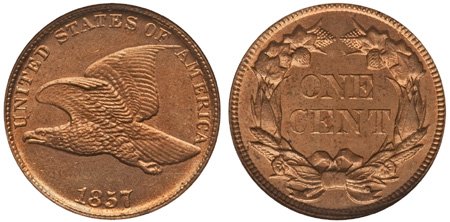
The design for the small cent would be created by Chief Engraver James Barton Longacre. The obverse features a flying eagle with the inscription UNITED STATES OF AMERICA above and the date below. The reverse features an agricultural wreath of corn, wheat, cotton, and tobacco leaves surrounding the denomination ONE CENT. The obverse was based on the eagle appearing on the silver dollars of the 1830’s designed by Christian Gobrecht. The reverse had been previously used on $1 and $3 gold pieces designed by Longacre.
Towards the end of 1856, the United States Mint struck several hundred examples of the new small cents for distribution to members of Congress, Treasury officials, and other important figures in order to gain support for the new format. The efforts were successful and resulted in the authorization of the small cent under the Coinage Act of 1857. The 1856-dated Flying Eagle Cents, which had been produced as patterns, were immediately popular with collectors. Some were fortunate enough to obtain an example from the original limited distribution. Others were able to acquire pieces from the Mint, which restruck and sold hundreds more examples over the next few years.
The Flying Eagle Cent would be struck for circulation from 1857 to 1858, during which time more than 40 million pieces were produced. The coins were minted in significant quantities since they were necessary to replace foreign silver and old copper coins still in circulation. On the whole, the switch from large cents to small cents was a success, however other problems became apparent. The small cents proved difficult to strike due to the hardness of the metal and the high relief of the design. This led to the development of the Indian Head Cent design, which would begin its lengthy run in 1859.